June 20, 2010 at 8:16 pm
· Filed under amanda, cheese, goat, making
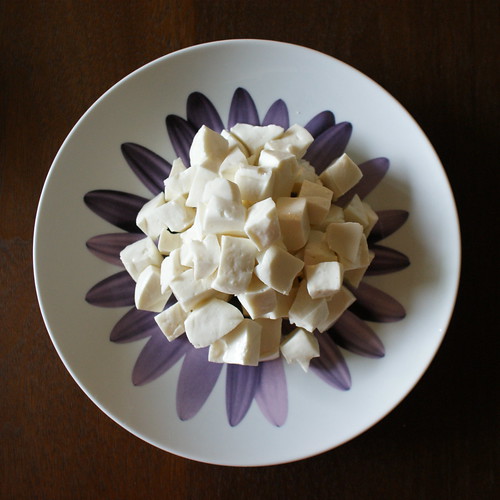
Holy hiatus, Batman! I have been incredibly busy, haven’t been making cheese and haven’t had time to write about some of the yummy cheeses I’ve been eating. However, lucky me, the ladies of FUCheese proposed a cheesemaking day and we actually made it happen. On the menu this time was something I’ve been wanting to make for over a year: feta!
Read the rest of this entry »
Permalink
September 10, 2009 at 5:55 pm
· Filed under amanda, cheese, education, events, making, supply
I was at Foster & Dobbs three times this week. I may have a problem. Last night they were having a meeting of the occasional DIY Cheesemakers group with a demonstration by Claudia from Urban Cheesecraft. She has started her own line of cheesemaking kits with products all sourced on the west coast. The whole kickoff for the FUCheese cheesemaking adventure was the Ricki Carroll mozzarella kit that Nicole got for Christmas two years ago. Ricki Carroll has great products but her supplies are in New England so you have to order and wait. It’s great to have a local option and Claudia’s kits are super adorable!
Claudia did a mozzarella demonstration for us and she was absolutely charming and very clear. She has a great, relaxed attitude about cheesemaking — you can’t mess it up! While cheesemaking is a science it is very often an inexact science so it helps to have a cheerful can-do attitude for when things go a bit sideways. I picked up some great tips from her and look forward to sharing them when Nicole and I do our own mozzarella demo for some friends next month — eek!
Claudia is planning to be at the Wedge Festival (be there!) with her kits and may also do a ricotta demonstration on the main stage. Kits are such a great way to jump in to cheesemaking, I highly recommend picking one up. You can find out on her website which stores in Oregon are selling them or order from her etsy shop. They would make such great gifts!
Also, if you want to get notified when Foster & Dobbs do their next DIY cheesemakers meeting or to hear about any of their other many events, sign up for their mailing list!
Permalink
August 2, 2009 at 5:29 pm
· Filed under amanda, education, making
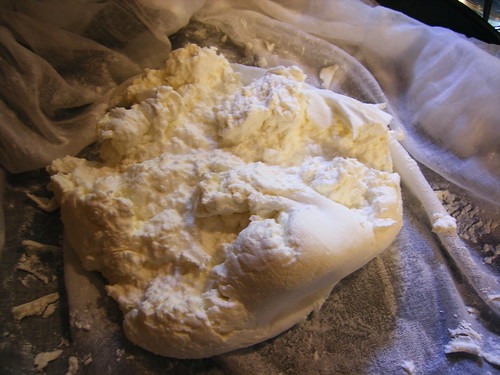
The main steps in making cheese are generally heating the milk followed by cutting the curds and then draining the curds to get rid of the whey. The less moisture in the cheese, the firmer and denser the cheese will be and the longer it can age. If you are making cheese at home, any of these steps can seem daunting, but sometimes the thing we have the most trouble with is the seemingly simple task of setting it up to drain properly.
The most obvious thing to do would be to have a hook in your ceiling over your sink which would allow the whey to flow right down the drain or be captured in a stock pot for another use. However, because of the soffit in my kitchen and the placement of the sink under it, this proved impossible. You may have other limitations. This post is a roundup of some of the devices we have conjured to drain our cheese.
Read the rest of this entry »
Permalink
April 30, 2009 at 3:04 pm
· Filed under amanda, cow, making, nicole, recipe
I haven’t had much experience with mascarpone. In fact, besides a few dessert recipes – think tiramisu – I didn’t know much about it when we decided to attempt it. It is in fact not a true curd cheese. It is often lumped in with the soft cheeses, but it is in the yogurt family. Like yogurt you make mascarpone by heating milk and then adding a culture. While there is some draining involved to get your desired consistency you don’t end up with curds like you do when making a true curd cheese. It is originally an Italian cheese from the Southern Lombardy region of Italy and while most famous for its role in tiramisu, it is delicious when used as a cream cheese substitute, both as a spread and in cheesecake.
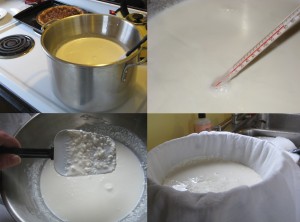
We decided to give mascarpone a go along with another batch of yogurt – who knew they were so closely related? We did two batches of mascarpone, both from Ricki Carroll’s book. One used a packet of direct-set creme fraiche starter and the other with tartaric acid. Each of these recipes was very easy and something that could be tackled in your home kitchen in a few hours. The mascarpone made with culture required you to heat the milk to 86 degrees and then let sit for 12 hours. It can be drained in the refrigerator for a few more hours if a thicker consistency is wanted. The mascarpone with tartaric acid required a 185 degree initial temperature before adding a 1/8-1/4 teaspoon of tartaric acid (I added a little over 1/8 of a teaspoon). Once the tartaric acid has been mixed in thoroughly it is set to drain in a colander for 1 hour. I actually let it drain for about 4 hours.
Read the rest of this entry »
Permalink
April 25, 2009 at 9:24 am
· Filed under amanda, cow, education, goat, making, recipe, tasting notes
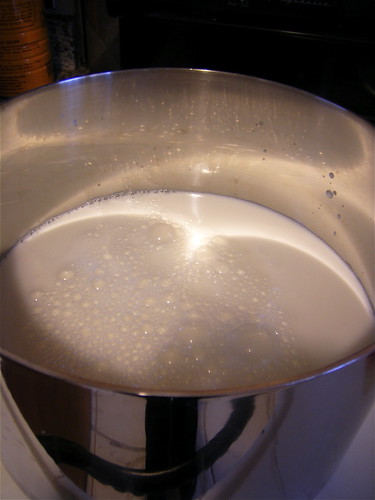
I probably won’t post every time I make another batch of yogurt as it’s so easy and I have a feeling that I have a lot of yogurt making in my future. But, for this batch, we took the yogurt making another step further by using a starter from our last batch.
Read the rest of this entry »
Permalink
April 21, 2009 at 4:23 pm
· Filed under cheese, cow, making, nicole
It’s taken me awhile to get around to this post, but a wee bit back in time – January 2009 – those of us at fucheese got together and had our first 2009 cheese event. Our purpose was to get back into cheese making after the hiatus brought on by the holidays, plan for the upcoming year, and show off holiday cheese swag.
There were a number of minor setbacks, even prior to the actual cheese making, mostly due to my ill planning and failure to read the recipe all the way through. (All things I made resolutions to correct this year.) Since we didn’t have the starter needed for Ricki Carroll’s recipe, we used one from The Home Creamery by Kathy Farrel-Kingsley. While a good time was had by all, the cottage cheese could have benefited from closer attention. Cheese making, I’m coming to realize, is really all about attention to detail and attentive monitoring. Not necessarily skills that I’ve honed in the kitchen as I’m more of a throw it all in a pot and see what happens kind of cook.
Read the rest of this entry »
Permalink
April 11, 2009 at 10:30 am
· Filed under amanda, education, events, goat, making, recipe, supply
Sometime last year, Sarah had scoped out that there was a place called Kookoolan Farms doing cheesemaking classes. They are $50 which isn’t a bad price at all but not so low that you wouldn’t think twice about it. We all agreed that we were interested and have been keeping an eye on the schedule. I saw that they had a Hard Cheese class for March and decided to go. Due to schedules, I was the only one of our group that could make it but I’m so glad I did.
Read the rest of this entry »
Permalink
February 14, 2009 at 8:46 am
· Filed under amanda, cow, dairy, making
I can’t say that yogurt was at the top of my list when I set out on this cheesemaking adventure (oh, sweet mancheeeegooooo….) but I am glad that I tried it. It is fairly simple to make and easy to source the ingredients. Everything can come straight from your happy local grocer.
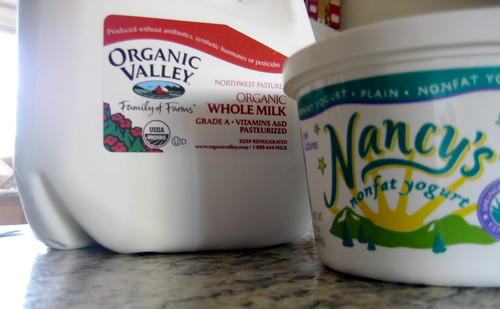
Read the rest of this entry »
Permalink
November 6, 2008 at 8:06 pm
· Filed under amanda, cheese, cow, making, tasting notes
So, I was going to come here and post “Cheese Fail” but I don’t think I necessarily need to do that. It’s not so much a FAIL as a sort of unexpected, somewhat of a downer outcome.
What happened is this: we have waited about thirty days for the cheese to age. Our plan was to cut into it this week. I noticed earlier this week that I could see mold under the wax. Oh noes!!! Investigation commenced this evening.
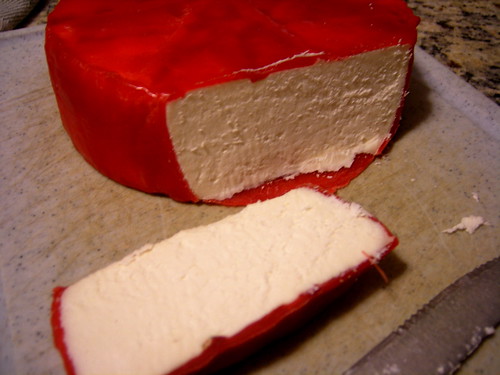
It doesn’t look too bad though not quite the texture I was expecting. It’s very light colored and has not much of a scent. Luckily there does not appear any mold running through the cheese. It’s firm but not hard. However, when you peel back the wax….
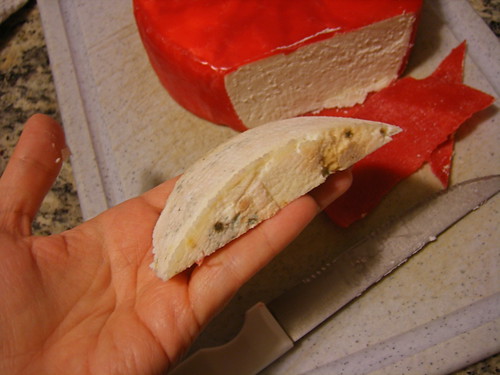
Bleh. Not good. Along the sides there is light veins of mold and on the top and bottom in all the little hollows there is some serious moldage. I cut off the moldy bits and my husband and I both tasted it. It’s slightly tangy and a little crumbly. I can’t say that it is anything like cheddar. It’s not bad, necessarily, but I wouldn’t call it exceptionally good. I think this weekend I’ll carve away some more mold and let some unmoldy bits come up to room temp and taste it that way.
I really don’t know what went wrong. Obviously, it was too damp when I waxed it. Before waxing, I had needed to wipe off a touch of mold and perhaps I didn’t get all the spores. I’m going to do some reading up on this but may attempt the farmhouse cheddar again as soon as this weekend. We’ll see. This is certainly a learning process and I’ve gained so much appreciation for cheesemakers.
Permalink
October 31, 2008 at 3:17 pm
· Filed under amanda, cheese, cow, making
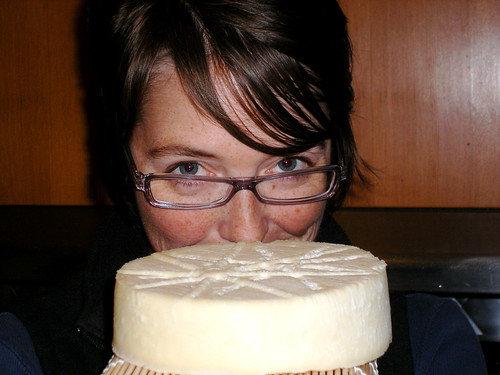
Here’s the little wheel of farmhouse cheddar we made. It has a rather pretty pattern on the bottom from the cheese press. We sat it out for about a week air-drying (perhaps should have been less) until it developed a thin rind. I think it smelled like buttered popcorn!
Read the rest of this entry »
Permalink